

The Story Grid Dojo
Daily practice that builds the skills to write a publishable novel.
Practice with a new assignment every day and get expert feedback from Shawn Coyne’s Craft Ladder™ Process within 24 hours.
Expert feedback on your writing, every day, from the method behind 35 years of bestsellers.
You don’t have a talent problem. You have an environment problem.
The average writer in our survey had been working on their writing for 14.9 years. Not because they lacked talent, but because writing is a wicked learning environment: feedback comes late, from the wrong people, or never at all.
You can practice on your own. You can break the skill into pieces. You can show up every day. But there’s one thing you can’t give yourself: expert feedback.
That’s what the Dojo is built around.
We’ve taught writers for over a decade. We built the Dojo from the ground up on the research of how skills are actually learned, and we’ve never seen more writers make faster progress.
Feedback from an editor’s method, not a chatbot’s opinion.
Every assignment you submit is evaluated by The Craft Ladder™ Process, a patent-pending method Shawn Coyne built from 35+ years as an editor and publisher, and from his study of story from Aristotle through modern philosophy and cognitive science. Across his career, 86% of the books Shawn published were profitable. The industry average is about 35%.
Why that matters
AI chatbots are built to tell you what you want to hear, and they give a different answer every time you ask. There is no fundamental standard they are judging against. They also don’t give you a clear path or process for improvement. The Craft Ladder applies the same standard to every passage, every time.
86%
of the books Shawn published were profitable
~35%
industry average
All feedback tells you exactly where your writing stands.
What's working.
So you know what to keep doing.
What isn't.
The specific problem, named.
Why it matters to the reader.
Not a rule. The effect on the person reading your pages.
What to practice next.
Your next assignment, chosen for where you are.
Yes, the Dojo runs on software. That’s how this is possible.
A good CPA doesn’t do your taxes by hand. They use software, so their expertise goes further, works faster, and costs less. The Dojo is the same idea applied to editorial expertise.
Working with Tim 1-on-1 costs $2,500 a month, and there are only 10 spots. Software is what lets us bring Shawn’s method to far more writers than a calendar ever could.
- It never writes for you. Every word is yours.
- The evaluation isn't a chatbot's opinion. It's Shawn's method, applied the same way every time.
- This isn't AI or LLMs. Feedback is given by The Craft Ladder™ Process, a patent-pending method built by Shawn Coyne.
- Your writing is never used to train AI models.
Where else can you get expert feedback every day?
Friends and family
- Expert?
- No
- Same standard every time?
- No
- Back within 24 hours?
- Sometimes
- Tells you what to practice next?
- No
- Affordable every day?
- Yes
Beta readers
- Expert?
- No
- Same standard every time?
- No
- Back within 24 hours?
- No
- Tells you what to practice next?
- No
- Affordable every day?
- Yes
Writing groups
- Expert?
- No
- Same standard every time?
- No
- Back within 24 hours?
- No
- Tells you what to practice next?
- No
- Affordable every day?
- Yes
AI chatbots
- Expert?
- No
- Same standard every time?
- No
- Back within 24 hours?
- Yes
- Tells you what to practice next?
- No
- Affordable every day?
- Yes
A developmental editor
- Expert?
- Varies
- Same standard every time?
- Varies
- Back within 24 hours?
- No
- Tells you what to practice next?
- Sometimes
- Affordable every day?
- No
The Story Grid Dojo
- Expert?
- Yes
- Same standard every time?
- Yes
- Back within 24 hours?
- Yes
- Tells you what to practice next?
- Yes
- Affordable every day?
- Yes
The math
A single developmental edit often costs thousands of dollars and takes weeks, for one manuscript. In the Dojo, after your first lesson you can submit multiple assignments a day, each analyzed within 24 hours. At $197 a month, that’s less than $7 a day.
Every condition for building a skill, built in.
- Separate practice from performance
- Daily assignments on short passages. You practice on exercises, not on the novel you hope thousands will read.
- Break the big skill into small ones
- A belt system that takes you one skill at a time, from inciting incidents to a finished novel.
- Expert feedback
- Every assignment is evaluated by The Craft Ladder™ Process, built by Shawn Coyne.
- Short feedback loops
- Your analysis comes back within 24 hours, with your next assignment.
- Daily practice
- 30 minutes a day. Small, focused reps that compound.
How it works: a day in the Dojo
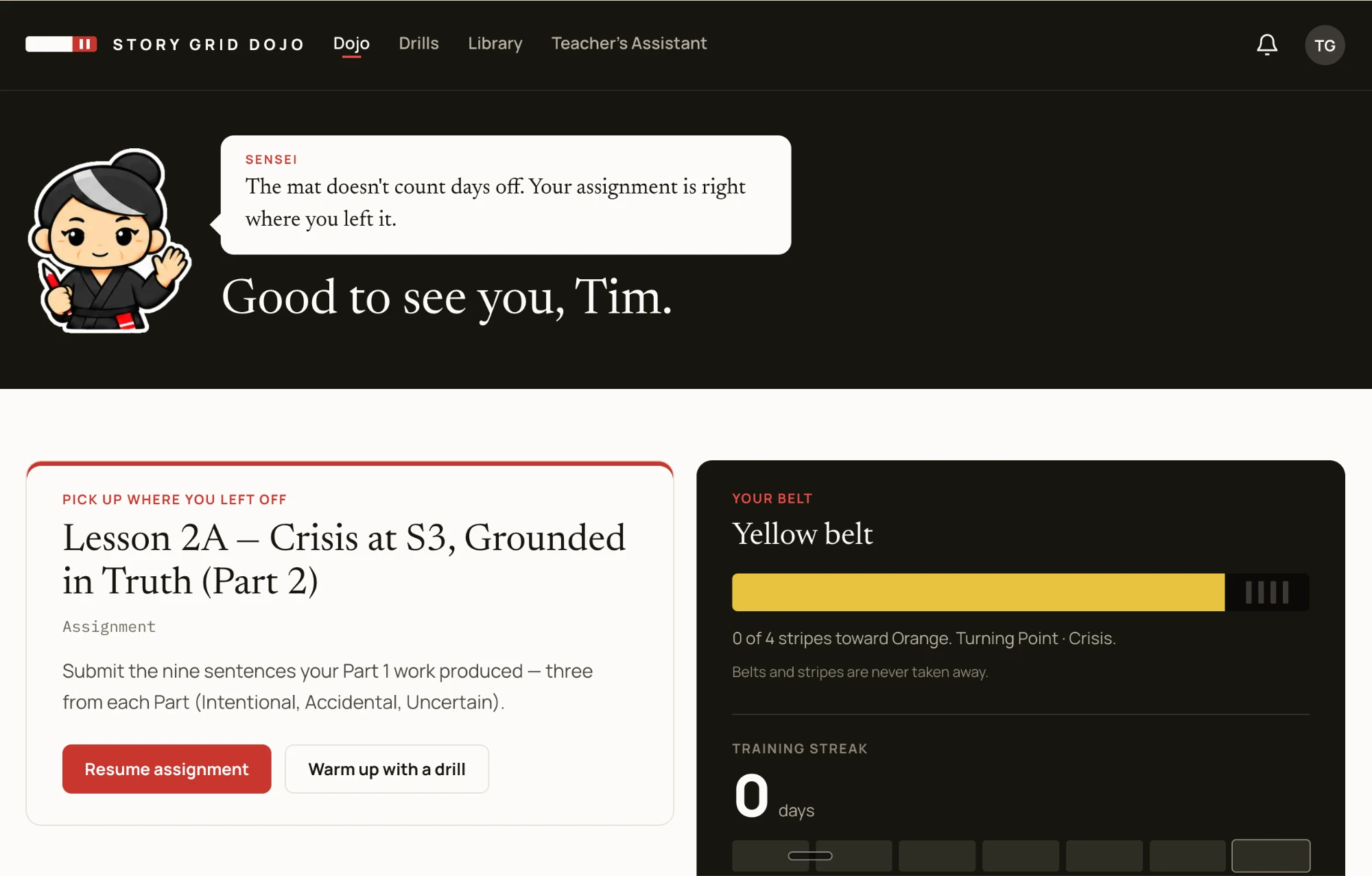
Log in.
Your next assignment is waiting at the top of the page.
Write and submit.
Read the instructions, write your passages, and hit submit.
Keep training.
Practice drills, watch lessons, or ask the Teacher's Assistant a question.
Get your analysis within 24 hours.
See what's working, what isn't, and exactly what to practice next.
After your first lesson, you can submit multiple assignments a day. Every one comes back within 24 hours.
Then do it again tomorrow.
Earn your black belt: a working first draft of your novel.
Like a martial arts dojo, you start with a white belt just for showing up. Every lesson you pass earns a stripe. Pass every lesson in a belt and the software moves you up automatically.
- WhiteYou showed up. Welcome to the Dojo.
- YellowInciting Incident & Progressive Complications
- OrangeTurning Point & Crisis
- GreenClimax
- BlueResolution
- PurpleThe Scene: write three working, publishable scenes
- BrownThe Short Story: write three working short stories
- BlackThe Novel: plan and write a working first draft
You’re never just learning structure.
Each belt focuses on one part of story. But every assignment, at every belt, also trains the craft readers feel on every page.
- Vivid, specific description
- Dialogue that sounds real
- Showing instead of telling
- Point of view
- Sentence rhythm
- Precise word choice
- Weaving in exposition
- Character voice
- Subtext
- Rising tension
- Pacing
- Believable character choices
Learn to see problems the way editors do.
The hardest part of writing isn’t knowing the rules. It’s seeing the problem on the page. The Dojo’s drills train that instinct the same way the world’s best are trained: rapid-fire examples, instant feedback, over and over, until you spot the problem without thinking.
Ask anything, anytime.
The Teacher’s Assistant is trained on the Story Grid canon and the methodology written by Shawn Coyne, so it answers from the method rather than from the open internet.
It also has access to your assignments and the feedback you’ve received, so it can help you work through your own pages, not just the theory.
It’s like having a teacher’s assistant who knows your work and Shawn’s methodology, available 24/7 to answer your questions.
Training library
Video and written lessons from Shawn and Tim on every skill in the path.
Practice at your own pace
After your first lesson, submit multiple assignments a day. Every one is analyzed within 24 hours, so you can move as fast as your schedule allows.
Your progress, visible
Belts, stripes, and a record of every assignment and every piece of feedback.
The skills are yours for life. So is the practice.
Professionals never stop practicing the fundamentals. Musicians still play scales. Athletes still drill. In the Dojo, black belts keep training too.
Think you don’t need help at the sentence level? Try this.
This passage has one specific, fixable craft problem. Can you feel it, name it, and fix it?
On her last morning in the house, Ellen walked through the rooms, taking in all the memories. She gathered her most treasured possessions and packed them carefully. Leaving this special place was the hardest thing she had ever done.
What Dojo students are saying
“I heard the advice “Show don't tell” for more than a decade, but I was lacking a framework to write what's observable. Happy to say that I finally unlocked it.”
The key to unlock that is practice from my side and expert feedback from the other side through an objective “yes/no” methodology that is not about individual taste or style but instead asking, “Does this sentence work? Yes or no?”
My confidence level as a writer just grew and I want to keep growing.
Alexander Kluge (naii.io)Germany “Big sigh of relief; I was worried that I was never going to get it.”
After weeks of frustrating effort, I finally got through Lesson 1 and Lesson 1B! Big sigh of relief; I was worried that I was never going to get it.
I am now looking for the beats in movies, shows, and books as I watch and read. I can now see how the lessons are applied.
Greg SmithOlympia, WA “I could not recognize my own telling and would have insisted it was showing until it was pointed out why it wasn't working.”
I learned which specific habits I lean on when I'm writing that keep me in the telling zone. Apparently I could not recognize my own telling and would have insisted it was showing until it was pointed out why it wasn't working. Very useful.
And, as frustrating as the repetition is, it's very helpful.
Anne MilneOntario, Canada “I can show someone knocking someone else's life off-balance then turn the heat up, yet not burn them.”
I can write a 3-sentence beat showing an inciting incident and a progressive complication, yet still leave it hanging, and it took guts to get there.
It takes a lot of repetition for me to understand the concepts I am learning.
 Gillian RutterPine Bluffs, WY
“Reading craft books and taking courses was frustrating and never useful.”
Who knew writing a true binary crisis was so hard? Over and over, I thought I had a crisis, only to learn so much about how I didn't. The depth of learning for each revision still astounds me.
I think it is difficult because I am learning what true writing is, and I had no clue before. Reading craft books and taking courses was frustrating and never useful. I have so much to learn.
Cynde HermanLos Angeles, CA “I needed to give the readers more to see so they could form their own inferences and be drawn in as co-creators.”
At six weeks in, I decided to spend some time evaluating a chapter in my book. I found it needed more purely showing sentences. I needed to give the readers more to see so they could form their own inferences and be drawn in as co-creators.
This crucial growth came from applying Shawn's feedback for each of my submissions and attending Tim's workshops.
Dawn BrooksPocatello, ID “At first it seems just like copying, but turns out copy work is a great way to understand a form.”
I passed 2A after several close misses. Every attempt got closer and closer. I keep the form of the scenelettes that I passed but changed what was happening to whom, building that muscle through repetition.
At first it seems just like copying, but turns out copy work is a great way to understand a form.
 Paul ProczkoChicago
“I leveled up Scaling Antagonism in one round.”
After spending so many rounds on worksheet 1A, I managed to complete worksheet 1B really fast. It took really examining the structure to get there.
Clement WeeSingapore “Cutting the beats to their barest form and showing every action and reaction and nothing else.”
 Curt LyndColumbus, Ohio
“The inciting incident, the automatic reflex and the complication on the Physical plane I can write now every time I sit down to write.”
I can tell the difference between when I am telling the reader something instead of showing through action.
Deanne NuttallSt. George, Utah “Then one evening I saw a few examples in a show I was watching and thought, that's what they mean.”
I wrestled with the beat-level exercises at first and felt like I wasn't getting it, but kept going. Then one evening I saw a few examples in a show I was watching and thought, that's what they mean.
Recognizing them in the greater world of story helped me keep going with the practice until I could do it myself. The structure matters.
ElisabethNashville, TN “To get here took Tim and Shawn correcting me and warning me about a gazillion times!”
I am watching for changing direction in one sentence or beat. I really have to PAY ATTENTION! To get here took Tim and Shawn correcting me and warning me about a gazillion times!
Thanks, Tim, for the extra help!!
Virginia S MoeWaynesville, NC “I finally understood how much specificity matters, and how to make a scene build on itself instead of starting over.”
The drills are what got me there. Seeing examples side by side, and recognizing why some worked and some didn’t, let me make my own writing work.
Elle BriggsUtah
The Dojo is for you if
- You write fiction, memoir, or narrative nonfiction
- You can give 30 minutes a day
- You're tired of the Writer Doom Loop and want real skills, not more knowledge
- You're just starting out, or you've been at this for years
- You want honest feedback, even when it stings
It’s not for you if
- You want someone to write your book for you
- You only want feedback that's praise
- You want a shortcut instead of a skill
Join the Story Grid Dojo
$297
$197/month
The beta is currently full.
Join the waitlist and we’ll email you as soon as more spots open up.
- Expert analysis of every assignment from The Craft Ladder™ Process, within 24 hours
- Multiple assignments a day after your first lesson
- The full belt path, from White to Black
- Unlimited practice on every lesson you've passed
- Rapid-recognition drills
- The Story Grid Teacher's Assistant
- The training library
Your teachers

Shawn Coyne
Founder of Story Grid
35+ years as an editor and publisher. Creator of the Story Grid methodology and The Craft Ladder™ Process. 86% of the books he published were profitable, against an industry average of about 35%.

Tim Grahl
Writer and Editor at Story Grid
18 years in publishing and author of six books. Spent over ten years failing to write a novel, 12 unfinished manuscripts, then learned the craft from Shawn.
Want Tim and Shawn in your corner?
Group Coaching and 1-on-1 Mentoring include everything in the Dojo, plus direct access.
Questions about the Dojo
Anything we haven’t covered, ask us at support@storygrid.com.
About 30 minutes a day.
The Craft Ladder™ Process, a patent-pending method built by Shawn Coyne. It isn't AI or an LLM.
Within 24 hours of submitting an assignment, along with your next assignment.
After your first lesson, you can submit multiple assignments a day, and every one is analyzed within 24 hours.
Your feedback isn't. Every assignment is evaluated by The Craft Ladder™ Process, a patent-pending method built by Shawn Coyne, not by AI or an LLM. And nothing in the Dojo ever writes for you.
No. Your writing is never used to train AI models, ours or anyone else's. Your feedback comes from The Craft Ladder™ Process, a method built by Shawn Coyne, not from a model learning from student work. Your assignments are stored so you can see your progress and so the Teacher's Assistant can help with your own pages when you ask, but reading your work to answer your question is not the same as training on it. Your writing is yours.
Everyone starts with a white belt. If you already have a skill, you'll pass those lessons and move up quickly.
The Dojo separates practice from performance, so you build skills on assignments first. The skills carry straight into your own pages, and at Black belt you plan and write your novel inside the program.
It depends on you. Most writers take one to two years to build from the sentence to a novel, and then the skills are yours for life.
Yes. The Dojo builds the skills behind any narrative writing.
You can keep practicing any lesson and getting feedback as often as you want.
Yes, anytime.
Stop looping. Start building.
Expert feedback on your writing, every day. A clear path to a novel readers will love.
The beta is currently full. Join the waitlist to hear when spots open.