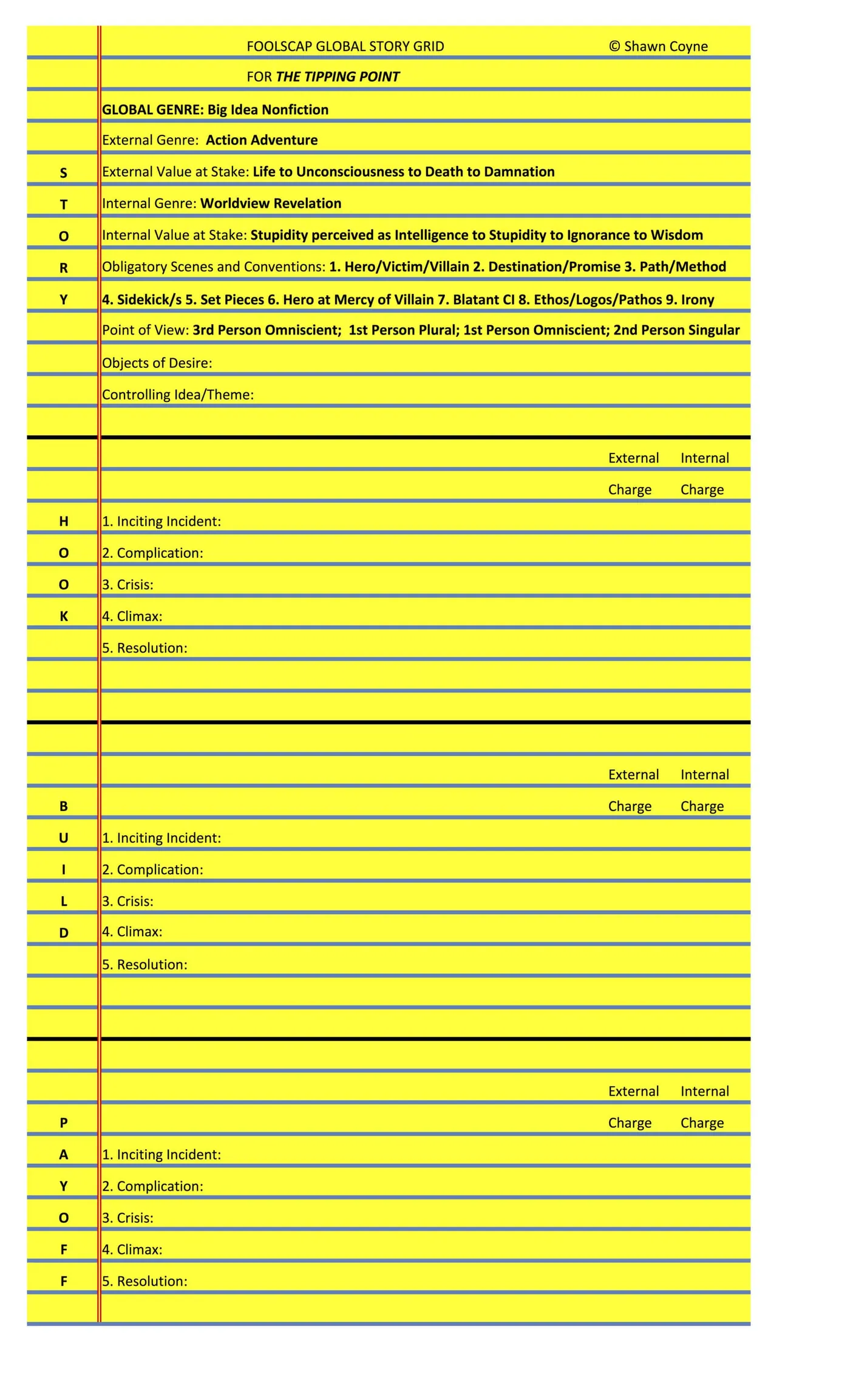

Storygridding The Tipping Point
Want and Need in Nonfiction
Your Debutante knows what you need, but I know what you want. A protagonist or multi-protagonists go on a mission at the beginning and by Story’s end, after overcoming or not overcoming forces of...
Shawn Coyne
6 minute read
Your Debutante knows what you need, but I know what you want.
Gladwell also knows what we need, but he's wise to give us want we want first. Guess which object of desire hooks our interest and which one lies underneath? Before I answer that, let’s take a step back and review exactly what these objects of desire are in a story and why they are so important. Here is a post dedicated entirely to objects of desire and their importance to global Storytelling. Here’s the bottom line that I’ve cribbed from that earlier post:A protagonist or multi-protagonists go on a mission at the beginning and by Story’s end, after overcoming or not overcoming forces of antagonism (inner, personal or extra-personal conflicts), he or they are irrevocably changed.
The 4 Steps to Writing a Publishable Novel
Free, on-demand training from Shawn Coyne and Tim Grahl. About 60 minutes.
But don’t forget though that something must happen at the very beginning of the Story—an event that throws the lead character’s life out of balance—the inciting incident.
Either a good thing happens or a bad thing happens. The event can be a random coincidence [aliens attack] or a causal occurrence [your lead character’s wife leaves him]. A positive change or a negative change in the life of the character unsettles his world and requires that the character do something to get back to “normal.”
Let’s see if The Tipping Point abides this must have Storytelling structure. [Archplot and Miniplot necessities] So first things first, a Story requires at least one protagonist. So who is/are the protagonist/s in The Tipping Point? With his courageous use of point of view (shifting from third person omniscient to first person and then second person after establishing his inciting incidents in his introduction) Gladwell sets himself up as the protagonist of the story. And his direct address of the reader invites him/her to join him on his quest too. So the protagonists of The Tipping Point are Gladwell and his readers. What happens at the beginning of The Tipping Point that throws Gladwell and his readers’ lives out of balance? What is the inciting incident/s? What happens is that Hush Puppies, a brand that had been all but dead in 1994 (30,000 sold), became wildly popular in 1995 (430,000 sold)…seemingly instantly. The shoes went from cheesy to cool overnight. At virtually the same time, New York City Crime plummeted from 2,154 murders and 626,182 serious crimes in 1992 to 770 murders and 355,893 serious crimes in 1997. Seriously? How did that happen? Somehow a dead product goes through the roof? And crime in what most people envision as the most dangerous city in the world nosedives? Are these things connected? How is that remotely possible? So two POSITIVE changes in the world (a product becomes wildly popular and crime falls) throw the protagonists (Gladwell and his readers) out of whack. Why and how did these things happen? So far so good. We have two inciting incidents that upset the lives of the protagonists of the Story. These events give rise to an object of desire in the protagonists…they want something. They want to know why and how these events happened. Can we delineate the conscious want of The Tipping Point more specifically? Remember that to figure out the want, we need to look at the external genre at play. That will define the want. In a crime story, the want is identifying and bringing the criminal to justice. In an action adventure story, the want is the prize at the end of the journey.. In The Wonderful Wizard of Oz, Dorothy wants to go home…the scarecrow wants a brain, the tin man wants a heart and the lion wants courage. Those are their conscious wants. And as you’ll recall, Gladwell describes his work as an intellectual adventure story, and like any journalist, he spells out exactly what the object of desire is for the reader and for himself. That old nonfiction saw “Tell them what you’re going to tell them… Tell them…and then Tell them what you told them” is all about concretely addressing the wants of the audience. Gladwell lays it on the line in the last three sentences of the Introduction.The point of all of this is to answer two simple questions that lie at the heart of what we would all like to accomplish as educators, parents, marketers, business people, and policymakers. Why is it that some ideas or behaviors or products start epidemics and others don’t? And what can we do to deliberately start and control positive epidemics of our own?
So the want for Gladwell and the reader is to figure out how to “Tip” things ourselves…we want a “Tipping” formula. The magic fairy dust that will make our product “go viral” and make us rich. This mission, to find the formula, is the on the surface external driving force of the action adventure story in the book. It's the want. What about the need of the protagonists in The Tipping Point? Is there one of those? Remember that the subconscious object of desire is what defines a need. And that the internal genre is the arena of the subconscious. Scrolling up to the top of our Foolscap page, we’re reminded that the internal genre for The Tipping Point is Worldview Revelation. And that the value progression of Worldview Revelation moves from “Stupidity perceived as intelligence” in its most negative form to “Stupidity (incapable of understanding)” to “Ignorance (capable of understanding but not having enough information to do so)” to “Wisdom.”