

Fundamental Fridays
Vetting Your Book Idea
Kimberly Kessler
13 minute read
In the epilogue of The Story Grid, Shawn Coyne says:
“The problem that bedevils most novice writers (and even some seasoned pros) is that they fall in love with the glamorous aspects of the literary trade--the romance of “the creative process,” the thrill of dashing off chapter after chapter in a white heat of inspiration, etc.--and they undervalue the blue-collar aspects of Story construction and inspection--understanding and mastering Genre, Story form, character, Story cast, and so forth. They fail to learn how to edit.”This blue-collar process doesn’t begin merely after the first draft--it begins at an idea’s inception.
Hard Truth: Not Every Book Idea is Worth Writing
Writing a story is an all-consuming process. It devours time, energy, brain power, and not least often self-esteem (can I get an amen?)—but it’s all worth it to tell a story that moves you and connects with your audience. In order to reach this coveted end, your concept must contain enough raw material to cut into a finished gem. The truth is, the price is too high to pursue story concepts that are less than worthy. Figuring out the difference between a concept better left as a thought experiment and one worth writing? This is a trademark of turning pro. But how? How do we objectively determine if our book idea is the diamond in the rough—or just rough? Is it possible to make this determination without a first draft? My blue-collar bones cry, “Absolutely, yes!”Primary Vetting Tool
Story ideas spark in an infinite number of ways. It can be an image, a line of dialogue, an abstract question...you name it. But whatever it is, that seed of the story must be expanded into a sizable amount of raw workable material. This raw material—the story concept—is what we are vetting. And what is our frontline tool for determining if our book idea has chops? The Six Core Questions Analysis. At its essence, the Six Core Questions Analysis is an abbreviated Foolscap Global Story Grid, and also one of the key diagnostic tools Certified Story Grid Editors use it to evaluate a draft. But even in the pre-draft vetting stage, the Six Core Questions provide well-rounded breadth and depth of the story concept--enough to make our prognosis and still leave plenty to be developed and imagined later. Answering the Six Core Questions is the Minimal Viable Product of a Story. Question 1: What is the Global Genre? Looking at Genre through Story Grid eyes is a distinct experience. It’s not the categories you see on bookstore shelves, it’s a set of specific information readers want to know before they partake. Shawn defines these through Genre’s Five Leaf Clover. Here in Question 1, we’re talking about the content leaf. Shawn lists 12 major content genres, which are divided into two main silos: external and internal. Some stories portray only one genre, but the richest stories will have both. The key to a story that works (and in our case, a concept with merit) is one of our genres, either internal or external, has to play head-of-household. This, then, becomes the global genre. There is no wrong answer, unless you don’t actively choose one. Remember, you can make changes later if you need to, but making this decision will make all future decisions immeasurably easier. Question 2: What are the Obligatory Scenes & Conventions? In other words, what are the audience expectations for your chosen global genre? If it’s Action, we’ll expect the hero/victim/villain triad. If Thriller, we’re waiting for the moment the hero becomes the victim. In Horror, we know the victim is the victim and the monster is the monster from the get-go. And so on a so forth for each genre. So, how do you figure out what your genre’s obligatory scenes and conventions are? Great question! First, by reading (ahem--and watching movies) in your selected genre, then by paying attention to what strikes you. What are the big moments of the story? What scenes make you sit up in your seat, or hide your face, or cry cry cry? These are the scenes that invoke the primary emotion of the genre, and they are what the reader is wanting when they pick up your book in the first place. In Pride & Prejudice: The Story Grid Edition, Shawn says: “The reasons why stories don’t “feel right” when they do not abide the genre’s conventions is that they are the key ingredients that combine to deliver the core emotion of a particular genre. Without clues and red herrings, there will be no sense of intrigue in a mystery story. Likewise, without the ten conventions inherent in Love Stories, the reader will not be spellbound by romantic feelings for the protagonist/s." Obligatory scenes and conventions aren’t cliche--they are the foundation for the reader’s experience. Question 3. What is the POV/Narrative Device? Who is going to tell the story? How are they going to tell it? This is a crucial decision, one that can completely transform the tone and meaning of a story. Your choice of narrator should never be arbitrary. It should get as much thought as your genre and be an intentional choice.- Single or multiple POVs
- 1st or 3rd person
- Use of Free Indirect Style or not
- Past or present tense
- Any other narrative device: letters, unreliable narrator, telling a story to children, framing the story by opening with ending and cutting back to the beginning, etc.
The 4 Steps to Writing a Publishable Novel
Free, on-demand training from Shawn Coyne and Tim Grahl. About 60 minutes.
Remember, character is defined by action. Clear WANTS & NEEDS articulate which actions your character will take.
Question 5. What is the Controlling Idea/Theme?
Now, at this early stage, this one may be difficult for you to nail down--partly due to that so much is discovered about a story as it’s written, but also because we all make the Controlling Idea/Theme much more complicated than it is.
The Controlling Idea/Theme is one sentence that sums up the argument your story poses and sets out to prove through its narrative.
Many writers claim they aren’t trying to prove any sort of universal truth, they just want to tell an entertaining story, and that’s fine. But their readers are going to find one anyway because humanity is hardwired to see meaning.
That said, it still doesn’t have to be complicated. The Story Grid provides a simple frame for capturing your Controlling Idea/Theme:
[Global Value at Stake] is [won/lost] when [specific circumstances of your story happen, often related to the internal genre].
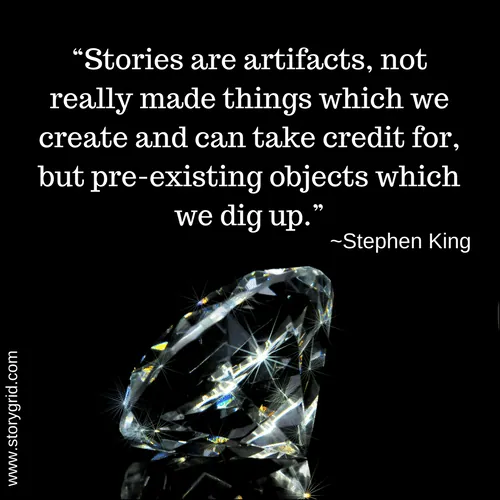 A book idea is like an uncut diamond sifted from the mud, raw material full of potential. Inside this jagged crystal are inherent possibilities, but not limitless possibilities.
Not every diamond crystal has the potential to be the next World’s Largest Diamond, just as every story concept doesn’t have the potential to be the next Pulitzer Prize Winner.
But who cares?!
Stories, like diamonds, don’t need to be colossal to dazzle and delight. They only need to realize their best size and shape. Keep this permission in mind as you vet your concept.
A book idea is like an uncut diamond sifted from the mud, raw material full of potential. Inside this jagged crystal are inherent possibilities, but not limitless possibilities.
Not every diamond crystal has the potential to be the next World’s Largest Diamond, just as every story concept doesn’t have the potential to be the next Pulitzer Prize Winner.
But who cares?!
Stories, like diamonds, don’t need to be colossal to dazzle and delight. They only need to realize their best size and shape. Keep this permission in mind as you vet your concept.
- Justice prevails when the protagonist engages her inner darkness as passionately as she does her "positive" side. (Silence of the Lambs)
- Love triumphs when we dispel base attitudes and embrace the vibrant mix of humanity among all social classes. (Pride & Prejudice)
- The Beginning: A specific character in a specific place/ time faces a specific obstacle
- The Middle: How they react and how the situation progressively complicates
- The End: Whether or not they overcome
Digging Up Your Gem
A book idea is like an uncut diamond sifted from the mud, raw material full of potential. Inside this jagged crystal are inherent possibilities, but not limitless possibilities.
Not every diamond crystal has the potential to be the next World’s Largest Diamond, just as every story concept doesn’t have the potential to be the next Pulitzer Prize Winner.
But who cares?!
Stories, like diamonds, don’t need to be colossal to dazzle and delight. They only need to realize their best size and shape. Keep this permission in mind as you vet your concept.
Digging Tools for Your Book Idea
In order to answer your Six Core Questions, you’re going to have to uncover more of your idea. Here are lenses to look through and tools for tapping and tinkering. Start with What You Know. I don’t mean this in the cliche write what you know, simply which part of the story idea came first? What piece did the Muse reveal to you?- Did you get a character?
- Did you get a setting?
- Did you get a “what if” question?
- Did you get a scenario? A scene? A conversation?
- Positive value (Love)
- Contrary value (Indifference)
- Contradictory value (Hate)
- Negation of the Negation (Hate masquerading as love)
- Intimacy
- Commitment
- Love
- Attraction
- Indifference
- Repulsion
- Hate
- Hate Masquerading as Love