

Story Grid
The Story Grid Translated Into Common Writing Terms
“Justice prevails when an everyman victim is more clever than the criminals.” A hotshot lawyer gets his first job.
Lori Puma
14 minute read
The Story Grid covers a lot of ground. With a 344 page book, over 120 podcast episodes, and more than 100 articles, it's a comprehensive resource on how to line up every element of your novel to craft a page-turning story that packs an emotional punch. But where do you start to try and absorb all that knowledge?
This is a primer on how the Story Grid matches up with 11 concepts and terms that most writers already know: genre, scenes, acts, narrative arc, theme, outline, plot, protagonist and antagonist, conflict, setting, outlines, and exposition. It's also a jumping off point with links to resources to dive deeper into a specific topic.
1. Genre
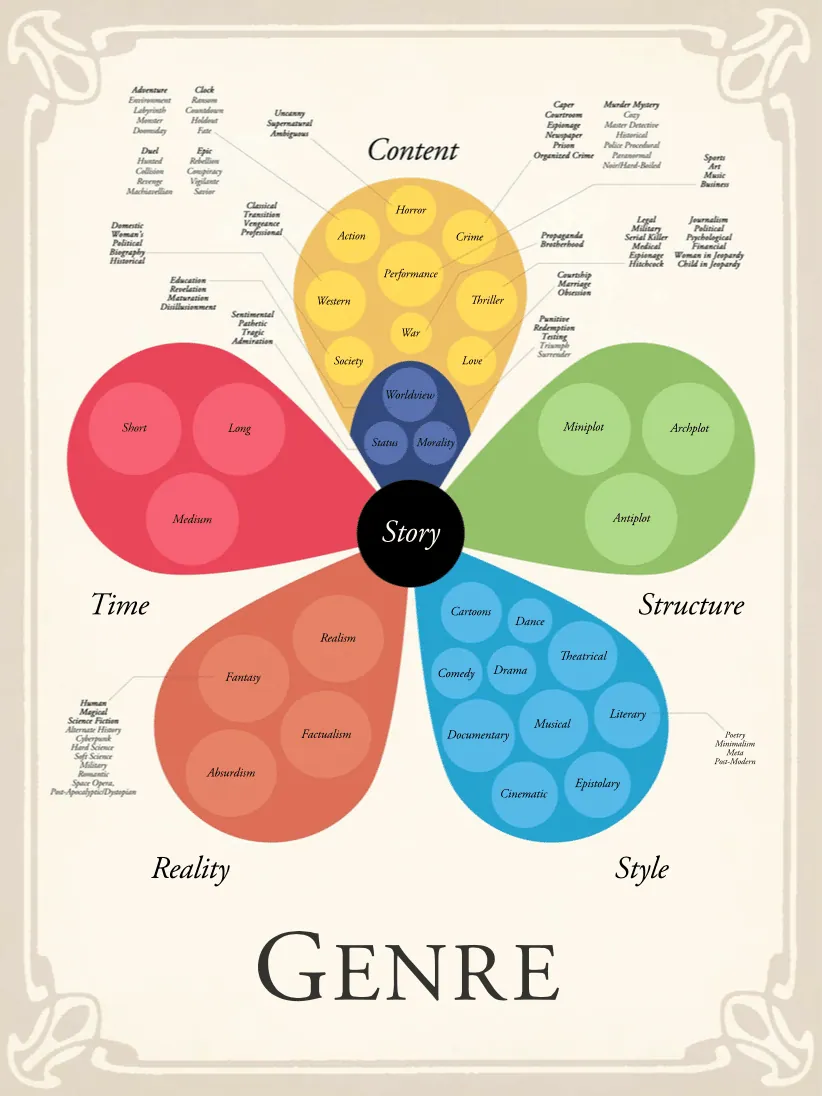
Genre is a method of categorizing stories that help set reader expectations for your book or screenplay. Getting genre wrong can lead to frustration and lost book sales. Getting genre right can be a boon to your career (and your bank account). The Story Grid splits genre into five leaves of a clover, each covering one aspect of a story - Time, Structure, Reality, Style, and Content. The Content leaf is the most useful in terms of constructing a story. It’s also what everyone talks about when they talk about genre. Let’s cover each leaf of the clover and then talk about how to find your genre. First, the Time and Structure leaves. As a novelist, you’re in the Long category in the Time leaf. As for the Structure leaf, if you’re writing genre fiction, you’re probably writing Archplot. If you’re writing literary fiction, you’re probably writing Miniplot. Next the Reality and Style leaves. In the Reality leaf, stories are categorized based on how much the audience will need to suspend their disbelief. The genres range from historically accurate biographies to fantasy or sci-fi that requires comprehensive suspension of disbelief. The Style leaf is about the sensibility and format of the story. Comedy versus drama. Literary prose versus musical versus epistolary (a.k.a. Made up diaries and letters) The Reality and Style leaves are useful in determining the sales categories to list your book on Amazon, but they don’t tell you as much about how your story should be structured. The Content leaf contains the genres that do help you structure your story. Each of the 12 content genres - Action, Crime, Horror, Love, Morality, Performance, Status, Society, Thriller, War, Western, Worldview -is associated with a specific Core Value and narrative arc (see section below). Each Content genre also has a set of five to eight obligatory scenes and conventions that readers expect to find in your story. The first obligatory scene is the genre-specific Inciting Incident, which kicks off your global story. One of the last obligatory scenes in your story will be the genre-specific Core Event, which serves as the climax of the global story. You can have more than one content genre, but one genre must be primary. See Story Grid Certified Editor and fiction author Valerie Francis’s in-depth article about genre and the impact finding her primary content genre had on her fiction career. How do you find your primary content genre? Listen to Shawn help Tim sort out his primary content genre based on theme in this podcast episode or read Story Grid Certified Editors Anne Hawley and Leslie Watt’s advice on how to find your genre through the Core Event in this article.
2. Scenes
Scenes are the fundamental building block of a novel and learning how to write a compelling scene is the #1 job for a fiction writer. In every scene, there must be change. A shift in life circumstances from beginning to end. From trapped to escaped. From alone to befriended. From overjoyed to grief. The way to create a shift in life circumstances is through a progression of events that obey the Five Commandments of Storytelling. Story Grid Certified Editor Rebecca Monterusso explains how the Commandments work in this article. You can also see how the Five Commandments apply to a specific story in this episode of The Author Copilot. Shawn and Story Grid Certified Editor and fiction author J. Thorn identify the Five Commandments in the Skittles commercial and mini-horror film Floor 9.5. As a new novelist, your focus should first focus on learning to write scenes that show a clear shift in life circumstances and abide by the Five Commandments. This post can show you how to improve your scenes. You can also listen to Shawn talk Tim threw examples of specific innovative scenes. A discussion of how Tarantino created a unique scene using a common scene trope - Stranger Knocks on a Door in Inglourious Basterds and an episode that includes a discussion of how Zero Dark Thirty and One Flew Over the Cuckoo’s Nest establish camaraderie (or lack thereof) in a surprising way.3. Acts
You can think of the Story Grid as a 3-act structure where each act represents a shift in the Core Value either positively or negatively. A hero accepts their mission. Someone dies. The rebellion wins the big battle. Each act has a name. Act 1, or the Beginning Hook, is the first 25% of your story. Act 2, or the Middle Build, is the second 50% of your story. Act 3, or the Ending Payoff is the final 25% of your story. The three acts must obey the Five Commandments of Storytelling and each contains one or more obligatory scenes which mark pivotal moments when the story shifts. The Climax of the third act tends to be the Core Event, the make it or break it moment for your protagonist, and the most important scene in your entire story. There are some great podcast episodes where Shawn and Tim talk through examples of obligatory scenes from Thriller, Action, and Love stories. This episode discusses the Hero at the Mercy of the Villain (the Core Event of a Thriller) in Guardians of the Galaxy. This episode identifies the All Is Lost (a pivotal moment in the Middle Build for many genres) in Silence of the Lambs and Pride and Prejudice. If you’d like to learn more about acts and get a rundown of all the obligatory scenes in a specific content genre, the Story Grid Editors Roundtable podcast can help. In each episode, five Story Grid Certified editors review a popular movie. They identify the content genre, obligatory scenes and conventions, and the events that make up the Beginning Hook, Middle Build, and Ending Payoff.4. Narrative Arc
The narrative arc is what creates an emotional bond between your protagonist and your reader. You want to create a narrative arc that focuses on one Core Value that represents the wants and needs of your protagonist. A Core Value defines the range of primal human needs relevant to your story. For example, Core Values might be Power to Impotence, Life to Death, Love to Hate, or Selfishness to Altruism. There’s a great explanation of Core Values in in this article by Story Grid Certified Editors Anne Hawley and Leslie Watts. The Core Value is genre-specific. In Action stories, the Core Value is Survival. You’ll have multiple scenes where your protagonist is in mortal danger. The entire story revolves around the question: Will the protagonist survive this ordeal? When a writer is clear on the Core Value, they don’t need a super-complicated plot. Readers intuitively sense the arc and are primed for the big, dramatic moments. When a writer isn’t clear on the Core Value, they often add plot points that confuse the story and make it harder to empathize with the characters. You know, like that feeling you had when watching Guardians of the Galaxy Vol. 2?5. Theme
In Story Grid, the theme is called the Controlling Idea. The Controlling Idea is a single sentence that says how the Core Value changes and why the Core Value changes from beginning to end. Here’s the Controlling Idea of The Firm, according to Shawn (p. 138 in The Story Grid: What Good Editors Know):“Justice prevails when an everyman victim is more clever than the criminals.”
The 4 Steps to Writing a Publishable Novel
Free, on-demand training from Shawn Coyne and Tim Grahl. About 60 minutes.
Story Grid Certified Editor Courtney Harrell wrote a great article about finding your theme by looking at yourself. Courtney also created a cheat sheet that lists the basic form of the Controlling Idea for each of the 12 content genres. This cheat sheet can help you make decisions about your story.
For example, let’s say you were planning to write a Thriller, but find that you’ve got a theme about respect and shame, which is associated with Performance stories. Now you know you’ve got a decision to make. What kind of a story do you want to tell? Do you want to tell a Performance story and focus on the respect and change theme? Or do you want to find a new theme that's more appropriate to a Thriller?
6. Outline
Story Grid has two outlining tools: the Story Spine and the Foolscap Global Story Grid. The Story Spine is a three sentence outline that can provide direction when you’re working on your first draft, but still leaves plenty of room for your story to develop organically. The Foolscap is a more detailed method that works best after you’ve completed a Professional First Draft and you’re ready to edit. The Story Spine explains the major events that lead to the Core Value shift across the novel. Each sentence of the Story Spine corresponds to an act. The first sentence describes the Beginning Hook. The second sentence describes the Middle Build. The third sentence describes the Ending Payoff. Here’s a Story Spine for the popular crime novel and film The Firm.A hotshot lawyer gets his first job.
The lawyer discovers his employers are criminals.
The lawyer outwits his employers and saves himself and his integrity.
You can listen to Shawn help Tim find the Story Spine for his first draft in this episode. You can also see more examples of Story Spines from popular stories in this post. The Foolscap Global Story Grid is a one-page outline of your story. It gets all the important details about your global story - the genre, controlling idea, POV, obligatory scenes and conventions on one page. It also goes into greater detail than the Story Spine on what happens within each act. Shawn explains the Foolscap in this video. You can see his Foolscap for the Silence of the Lambs in this post. https://www.youtube.com/embed/Njx9Bee4po47. Plot
A good plot is like a 100,000 word sudoku puzzle. It’s a unique solution to a logic problem that fulfills these criteria.- Focused on a shift in Core Value from start to finish of the novel.
- Includes all the obligatory scenes of the primary content genre.
- Involves characters making choices that become more and more irreversible over the course of the story. The consequences of those choices escalate in terms of the number of characters affected (from a single person to the whole of humanity) or escalate in terms of the personal relevance of characters affected (from a stranger being attacked to the protagonist herself or the loved one of a protagonist being held hostage), or both.
- Comprised of scenes with clear changes in life circumstances for the characters that vary in type, they don’t repeat (For example, repetition would be three scenes in a row where the protagonist loses something important. First a job, then the dog dies, and then their romantic partner leaves them.)
- Comprised of sequences with clear changes in life circumstance that represent bigger life changes than what happens in scenes and that vary and don’t repeat.
- Comprised of acts with clear changes in life circumstances that represent larger changes than in individual sequences and that reflect the Core Value from the primary content genre. The amount of change for an act is larger than the change for an individual sequence and acts must vary and not repeat.