“Do you think if you caught Buffalo Bill yourself and if you made Catherine all right, you could make the lambs stop screaming, do you think they’d be all right too and you wouldn’t wake up again in...
Shawn Coyne
·
37 minute read
Next comes the MIDDLE BUILD, the longest and most challenging section of a novel (about 50%) to keep the reader in suspense. You’ll not find a finer execution of a Middle Build than The Silence of the Lambs.
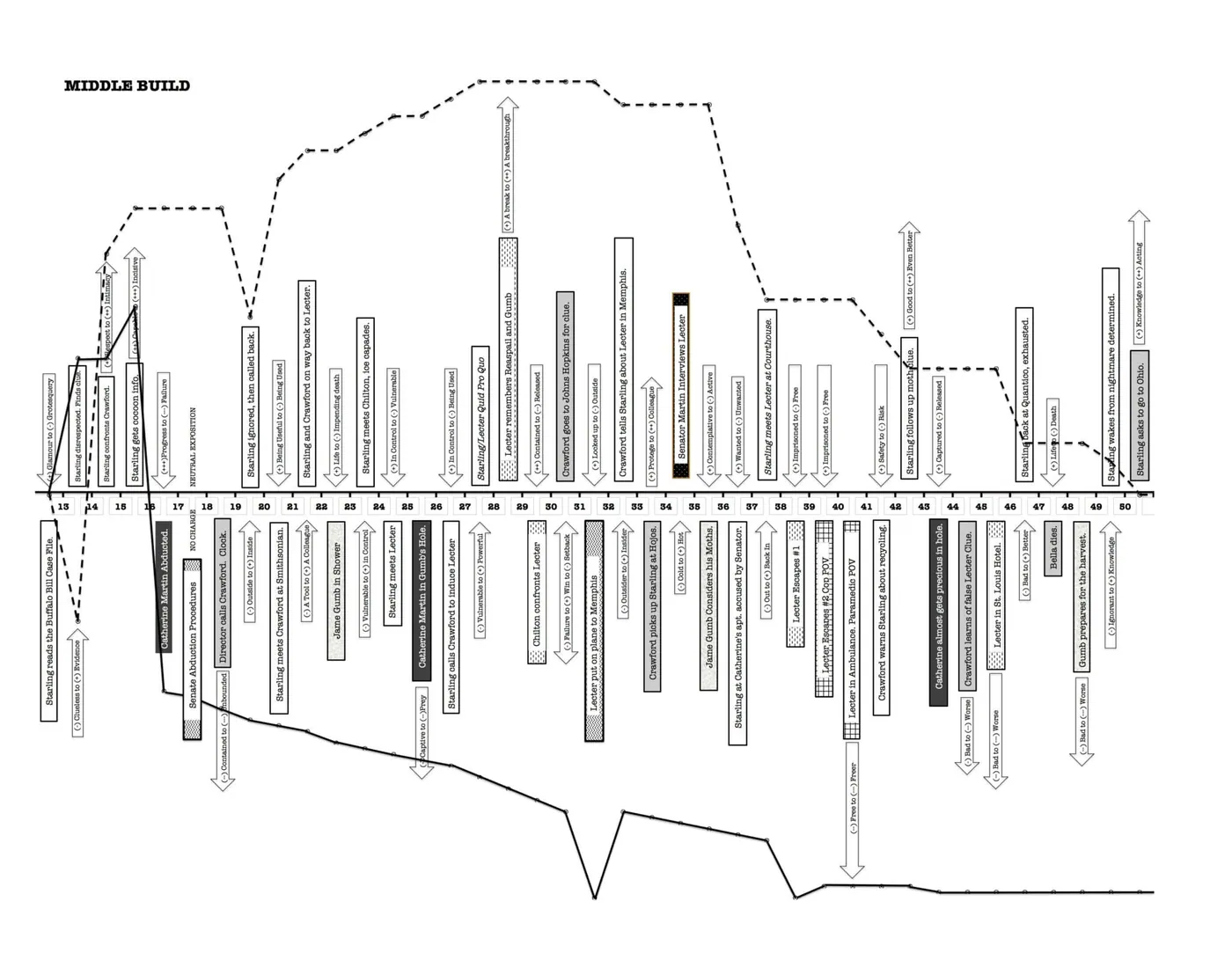
Using our Foolscap Global Story Grid and our Story Grid Spreadsheet, I’ll do the exact same thing we did for the Beginning Hook of the book for the Middle Build. I’ll boil down each scene event that I’ve written on my Story Grid Spreadsheet to the shortest possible phrase or sentence that tells us what’s happened. I’ll then write down the event above or below the horizontal line to designate the value shift of that particular scene. So if the scene moves from a positive to a negative value charge, I will put the label for that scene beneath the x-axis. If the scene moves from a negative to a positive charge, I will put the label for that scene above the x-axis.
We’ll track the movement of the “Life” and “Worldview” values in the y-axis too.
The “Life” value (straight line) will grow ever more negative until the “all is lost” moment when the FBI and by association Starling is the furthest away from identifying and capturing Buffalo Bill. You’ll notice that the “all is lost” moment comes just about at midpoint of the entire novel. That is no coincidence!
As for the “Worldview” value (in dashed line), it will rise to its greatest height in scene 27 (chapter 25) when Starling with complete faith in the meritocracy and righteousness of the FBI makes the Faustian bargain with Hannibal Lecter. She’ll open up her inner world to him in exchange for his help finding Buffalo Bill. She soon finds out that this decision will haunt her the rest of her life.
Here's the MIDDLE BUILD portion of The Story Grid.Middle Build of The Silence of the Lambs
The Inciting Incident for the MIDDLE BUILD is the discovery of the “floater” in West Virginia. This is the third dead body introduced in the novel. The first you’ll remember is the suicide of Miggs and then the floating head at the storage unit. Harris is raising the stakes in the Story with the increase in body count. Having the Buffalo Bill bodies (Miggs was a result of Lecter’s work) submerged in fluid is also an apt metaphor for the haziness with which Starling and the FBI see the world. The life value is definitely in the death arena.
In the early stages of the Middle Build, her internal “justified belief” value is gaining in positivity. She’s doing great work and being rewarded. Cause and effect are seemingly in sync.
But what’s with that dip in scene 14 (chapter 12)?
That dip is Harris creating the perfect progressive complication to get Starling (AND THE READER) to believe in the righteousness of Crawford and the FBI to an almost unassailable level. Harris needs this dip in order to make Starling’s later decision to sacrifice her inner peace for the good of the FBI (and for what she thinks her rewards will be for doing so) believable.
She’s not an idiot for agreeing to allow Lecter inside her brain. Crawford is manipulating her to do so. She’s been victimized by her mentor (Crawford) and the institution that he represents to her, thus making the reader empathetic to her plight.
But if Harris doesn’t fortify the “fairness” of Crawford at this point, the reader may not completely empathize with Starling at the crucial moment in the novel for the protagonist (the stand-in for the reader)...the point of no return.
Here is that dip moment again.
When Starling and Crawford are in West Virginia, Crawford disrespects her in front of the local police by barring her from a confidential meeting about the dead girl. Starling takes offense and momentarily questions whether this is a Standard Operating Procedure in the FBI. Do the higher ups use the agents below them in order to amplify their power?
This dip is the representation of her momentary questioning of the core righteousness of the FBI. It’s sort of a “wait a minute, am I being played?” inner doubt in Starling. And it’s simply brilliant.
When they return from West Virginia after Starling has discovered another crucial bit of evidence (the moth cocoon in the throat of the victim), Starling is emboldened. She confronts Crawford about the disrespect. Crawford cops to it and then gives her a very reasonable and clear explanation about why he dissed her. This moment in the novel jacks up the internal value toward the positive even more for Starling. Her “justified belief” in the meritocracy and order of the FBI is not only restored but is much higher than it had been before.
Harris ends the chapter with these two sentences. “She would have killed for him then. That was one of Crawford’s great talents.” There is no doubt that Crawford has done this sort of manipulation before...it’s one of his best plays in his playbook.
You’ll also notice that in scene 13 (chapter 11), Harris satisfies the “speech in praise of the villain” thriller convention in the form of having Starling read and review Buffalo Bill’s case file. This killer is brilliant...seemingly impossible to catch...he leaves no clues. We’ll make a note of this on our Story Grid later on and check off the requirement on our Foolscap Global Story Grid.
Let’s move forward.
Just as Starling is getting traction with Crawford, in scene 17 (chapter 15), Harris raises the stakes again. He moves the life value at stake from investigation of old death to the real threat of future death with the abduction of a senator’s daughter, Catherine Martin. In addition, Harris has now thrown in a clock plot to his Story, another popular feature of the thriller. If the FBI doesn’t get some breaks, a woman will die. Harris literally establishes the clock at the end of scene 18 (chapter 16) with an exchange between the FBI director and Crawford, “What have we got at best—six or seven days, Jack?”
Why does Harris use a senator’s daughter as the victim?
He’s setting up Starling’s disillusionment plot. It has to make sense. So Harris has set up a dramatic difference between Buffalo Bill’s victims. A senator’s daughter is going to get a full court press. But what about victims like Fredrica Bimmel? Girls/women from the coal mines just like Starling? They get dehumanized, just bodies in a timeline. They don’t matter.
With a senator’s daughter at stake, the FBI will be put under serious duress and will be politically vulnerable. And when institutions come under duress, their true characters reveal themselves. Stress threatens the institutions’ order and hierarchy. Because institutions are just collectives of human beings with no real soul of their own (unless they are benevolent tyrannies that is), when bad things happen to them, most people run to protect themselves. And they look for sacrificial lambs to offer up if the shit really hits the fan. Fall guys to blame. Harris uses the serious threat of political reprisal as a way to reveal the truth about the FBI. Is it really the roses and sunshine meritocracy filled with stern but benevolent mentors like Jack Crawford that Starling believes? Or is that myth just a convenient mask that men like Crawford use to cover up the realities of the institution?
If Harris did not use the daughter of a powerful figure as the victim, the motivations of the people within the FBI and the ancillary antagonists like Dr. Chilton would not be as clearly delineated. The “importance” of the victim increases the urgency.
Harris is also using Catherine Martin to show (not tell) how there is a very real difference in value of her life versus the previous victims. The other women who were killed and flayed are referred to more as evidence than they are as human beings. They’re pejoratively “the Bimmel Girl,” “the Kittridge girl from Pittsburgh,” “the next one he grabbed,” “the one after,” and “the Varner woman.”
The subtext here is that what was once a plodding, clinical investigation into the murders of run of the mill every-woman is now the number one priority of the FBI. And it’s all because of the serious value of Buffalo Bill’s next target. If he’d grabbed a waitress instead of the daughter of a senator, he’d get away with it.
I’ll get into this a bit more later on, but what makes Starling so effective as an investigator is her ability to identify with the unnamed, “lesser” victims. And how she comes to that realization that she should look at the world through their eyes instead of trying to “be the killer” (the investigative innovation in Red Dragon and the FBI Behavioral Science Unit itself) is what breaks the case. It is in these details that you see how Harris outdid himself with this novel. He turned the whole investigative MacGuffin of Red Dragon (Will Graham sees the world through the killer’s eyes) around in The Silence of the Lambs (Starling sees the world through the victims’ eyes).
The force that makes Starling come to a true understanding of herself is also extraordinary. Which character forces her to accept herself for who she really is, “not one generation out of the mines,” and drives her to this realization?
It’s none other than the incarnation of evil...Hannibal Lecter. This is one of the reasons why the reader can’t help but love Lecter. So much so that the reader even overlooks the fact that he’s a cannibal. The reason why is that he’s the only one who actually cares about Starling, wants her to find truth and live with it. Instead of living in lies and being a toady to a corrupt institution. Lecter may have not said this, but it’s absolutely something he would agree with...a quote from John Milton’s Lucifer in Paradise Lost “Better to reign in hell than serve in heaven.”
Harris has Lecter see through the bullshit around him and to not sit idly by. He acts and punishes the venal poseurs in life. And he’s a real sucker for a regular Joe who has the courage to be comfortable in his own skin. Isn’t that the kind of person we’d like to be too? Not only someone who can separate the noble from the political, but someone who has the nerve to take up arms against the wicked and help the naïve defend themselves? Without the whole cold-blooded murder and cannibalism element of course, to abide by the Lecter code would be admirable, no?
Another way Harris sets up Starling’s disillusionment is in scene 20 (chapter 17). After the news that Buffalo Bill has kidnapped Catherine Martin becomes public, Starling assumes that Crawford will pull her out of class again and have her join the investigation.
But he doesn’t.
You’ll see on the graph that there is another dip to represent this disappointment, which again only makes the reader more empathetic to Starling.
She’s gone to great lengths to be ready to join Crawford when she hears about Martin. She even jumps in the shower with another trainee to speed up her preparedness. But instead of being Crawford’s first call, she is forgotten, ignored.
Crawford does not share her expectation that she’s become indispensable to the investigation. Crawford needed a nice looking woman to goose Lecter into giving up some information and he needed someone familiar with the provincial nature of West Virginia who could also do fingerprinting. Starling happened to fit the bill for both of those errands, so he pulled her out of class. But now, she’s an afterthought. For Crawford, she’s done what he needed of her (getting Lecter to give information), so now she’s disposable.
Harris is using Starling’s disappointment as a way to reinforce the fact that all is not what it seems at the FBI. Jack Crawford is not the benevolent mentor that he seems to be. But Harris is not quite ready to make Starling give up on the institution. Instead he’s raising the stakes again. Crawford disappointed her once and he made up for it. He’s definitely disappointing her again when he ignores her.
How many more times will Starling need to be disappointed before she sees the truth?
As an aside, it’s interesting to note how Harris is playing out this relationship. It’s sort of like a high school romance. The girl lets a boy know she’s interested in him, he responds, she then pushes him away, he’s devastated until she comes back again and he’s even more in love with her. Not unlike a dysfunctional parent/ child relationship either. This is a purposeful choice on Harris’ part. No question.
Harris does have Crawford call for Starling at the very end of the scene 20 (chapter 17) to rejoin him in the investigation. But the reason Crawford does so is not because he feels he should, but because he needs to use Starling again. It’s because the head that Starling found in the storage unit, through Lecter’s intercession, also has a moth cocoon inserted into its throat. Just like the one she found in the body in West Virginia.
That information necessitates that whoever killed the man whose head was stuck in the storage unit probably killed the floater in West Virginia, the other body with a cocoon in its mouth. And both are probably the work of Buffalo Bill. So Starling, the only one to unearth the head in the jar and the only one to see the cocoon in the West Virginia body, has connected Buffalo Bill with Lecter. So Crawford pulls her back into the investigation based on merit, yes, but also because she’s the catnip that will get Lecter to play along and give up more information. The complicated and political nature of the FBI is now coming into focus. For the reader. But not necessarily for Starling. She’s too focused on her object of desire (to become a valued and celebrated agent in the FBI) to step back from her tenacious striving to see the real truth.
When Starling hears that Crawford’s decision to bring her in was based on the discovery of the cocoon, her justified belief in the FBI is restored and is now almost sacrosanct to her. You can almost read her thoughts.
It is a meritocracy! Whew!
So when Crawford tells Starling that she has to go back and talk to Lecter again, she doesn’t hesitate. She doesn’t stop to think that Crawford’s using her... Again! She thinks now, wholeheartedly, that she should do what she’s told. And if she does that, and does it well, she’ll get what she wants. Crawford will give it to her because she’s earned it...
Meanwhile, while Starling’s worldview grows ever positive, the Story’s external life value, life/death, gets more negative. Onstage death (as opposed to the discovery of dead bodies) is becoming more and more inevitable. With the earlier establishment of the clock ticking after Buffalo Bill’s abduction of the senator’s daughter, it’s clear that the FBI has no real clue who Buffalo Bill is or why he’s doing what he’s doing. It’s so clueless, it’s relying on a trainee to do the hard legwork in the case.
Harris makes this FBI cluelessness clear by giving Buffalo Bill (Jame Gumb) his own chapter (20, scene 23). This is Gumb’s first appearance on stage and it’s very strange and frightening, but what’s remarkable is its specificity. This guy is off the reservation and no one has any idea who he is, let along where he is.
Back to Starling.
So, emboldened by her success finding the cocoon in West Virginia and getting the lead to the head in the jar from Lecter and her justified belief in the FBI, Starling goes back to see Lecter in scene 25 (chapter 22). She finds him about twenty steps ahead in what’s going on.
Lecter schools Starling and warns her about how she’s being played by Crawford and company. And he even tells her how she’ll save her own life at the very end of the book (it has to do with the smell of goat). But Lecter won’t tell Starling WHY Buffalo Bill is doing what he is doing until she agrees to confide in him.
Remember that the WHY? for the antagonist is a convention of the thriller. It’s called the MacGuffin. What’s so smart about Harris is that he understood, before anyone else, that the real life FBI Behavioral Science Unit itself was an effort to search for MacGuffins. The thinking is that if we know WHY killers kill, what they get out of it, we’ll be better equipped to stop them. Obviously the pathology goes much deeper than the above the surface object of desire for a serial killer, but it’s the first stage to getting into his internal object of the desire. Discovering the ways in which the killer acts out those desires leads to his comeuppance.
Back to the Story.
In order to get her external object of desire (to become a respected FBI agent), Starling must allow the most brilliant killer in the world into her mind. What’s great about this demand beyond the fact that it is a masterstroke in “Best Bad Choice” crisis questions, is that Lecter spells out the quid pro quo directly. He doesn’t manipulate Starling. He tells her what it’s going to cost her right up front. Crawford and company, on the other hand, deceive her.
Because Starling has just experienced the rush of fulfilled ambition from what she sees as her own merit, she agrees. She tells Lecter her worst memory of childhood. The quid pro quo, a Faustian bargain that will become more explicit and meaningful in a later chapter. Lecter also knows that Starling’s monomaniacal ambition (as well as the ambitions of the creepy head of the hospital, Frederick Chilton), will deliver him from captivity.
He’s made plans from the very first meeting with Starling based on knowing what everyone will do before they actually do it.
Scene 25 (chapter 22) culminates with Lecter explaining the MacGuffin.
He tells Starling that Buffalo Bill wants a vest with “tits on it.” Buffalo Bill believes he’s a woman and is making his own woman suit out of the body parts of his victims. I love the way Harris has Lecter use profanity here. The subtext is that the killer sees women as objects with interchangeable body parts—just like the FBI views victims who aren’t senators’ daughters.
Lecter then sends Starling away to get him a deal, knowing full well that Dr. Chilton is monitoring everything he’s saying. Lecter is setting up his own escape by admitting that he knows who Buffalo Bill is. But it is important to remember that Lecter never lies to Starling or plays her like Crawford does. He’s giving her just enough of what she’ll need to catch the killer if she has the courage to see through the bullshit. But not one bit more.
Harris breaks away from the investigation after the MacGuffin is revealed to give us the point of view of the human being who will provide Buffalo Bill’s vest, Catherine Martin. We see what she’s going through and it’s horrifying. Every second the FBI wastes...death gets closer. Add the fact that she’ll be flayed and her chest will be sewn into a suit worn and paraded around by some mad man is definitely in fate worse than death territory. And we’re only midway through the novel!
This is masterful construction of Progressive Complications. Now you know why the MIDDLE is called BUILD. And the view from the pit humanizes a prurient detail. It’s as if Harris is telling us not to forget that the vest with tits is a human being. And for all of our rooting for Starling and her ambitions to make the grade, there is a person about to be slaughtered for every second she and her fellow FBI agents waste.
To repeat, the peak of Starling’s justified belief arrives in scene 28 (chapter 25). She throws herself all on the line and agrees to give Lecter what he wants, entree inside her mind to her deepest thoughts—a sexual metaphor if there ever was one. She does this because she believes unequivocally that the FBI and the senator are telling the truth. They’re backing her up and they’ll live up to their promises. She believes they will protect her from Hannibal the Cannibal.
But Lecter knows that the FBI and Crawford are lying to Starling and he will use that knowledge to escape, but he also can’t help himself from falling for Starling. This is why he’s decided to help her find the truth about herself. In exchange for his penetration into her mind, he’ll help Starling find Buffalo Bill all by herself too. If she’s as smart as she thinks she is. What she does when she finds Buffalo Bill, though, is up to her.
Lecter also decides to give her a critical piece of information...the information that will save her from Buffalo Bill. All she has to remember is that schizophrenics smell like goats. Remember this scene? Scene 25, chapter 22? Lecter explains to Starling why Sammie, his new cellmate after Miggs killed himself, smells like a goat. It is this explanation that will clue Starling in to the fact that Sammie and Buffalo Bill share the same affliction. So in the climax of the entire novel, she’ll remember that little tidbit and save herself. If you also have any doubt that Lecter knew who Buffalo Bill was and in fact where Jame Gumb lives...just go to the very first meeting between Lecter and Starling and you’ll notice that he’s made a drawing of the Palazzo Vecchio and the Duomo in Florence, Italy. He makes a special point of letting Starling know that he’s drawn the scene as it would look from the point of view of the Belvedere.
Buffalo Bill/Gumb lives in Belvedere, Ohio. Talk about setting up a clue and paying it off!
He’s mocking the FBI with his artwork at the very beginning of the novel (and at the end too) and they don’t even know it. The only one who comes to understand how important his artwork is? Starling.
Also in scene 25 (chapter 22) Lecter tells Starling that Buffalo Bill is all about “change.” Buffalo Bill wants to change himself, but he’s wrong about the course he’s taking to do it. Lecter knows that this yearning for change mirrors Starling’s. Starling wants to shed her West Virginia, white trash, coal country past and become an important person, a crack FBI agent. If she can do that, she’ll also avenge her father’s death, the murdered night watchman who died when she was just a little girl.
Jame Gumb, the man behind the Buffalo Bill robe, wants to don new skin too. But he wants to do it...literally.
Lecter knows that by giving Starling the clues to understand why the killer is doing what he’s doing, she may come to understand that she is metaphorically doing the same thing. The irony Lecter is trying to convey to Starling is that the only way she will be able to catch the killer is by being true to who she is... especially the nobody West Virginia girl part.
Of course, Thomas Harris never spells this subtext out. It reveals itself to the reader upon reflection. And even if it doesn’t, the specificity of the telling is enough to sit with the reader for years.
Back to the clues. In scene 28 (chapter 25), Lecter tells Starling to look for men who have applied for sex changes but who have been turned down for the operation. To look for one person who has been turned down at every clinic in the country. The work required to do this, Lecter knows, will take the FBI far longer than it will for Gumb to kill the senator’s daughter. But it’s righteous information nevertheless.
Lecter’s counting on the delay in getting the sensitive sex change information to enable him to escape.
Scene 28 (chapter 25) represents the peak of the positive worldview for Starling. She believes in her role in the FBI so intently that she opens up her subconscious self to Lecter. From this point forward, Starling is going to get a deep lesson in the realities of the institution she’s sacrificed for.
Back to the external value shift.
After the big break that Lecter gives Starling in scene 28 (chapter 25), Harris triples down on the forces of antagonism.
He takes us into Lecter’s brain in scenes 29, 30 and 32 (chapters 26, 27 and 29) letting us know that he knows exactly what he’s doing. He’s going to use the ambition and venality of Dr. Chilton to get him out of Baltimore. Chilton is so stupid that he thinks he’s going to pressure Lecter into giving up Buffalo Bill all on his own. And then in scene 31 (chapter 28), Crawford goes to Johns Hopkins to follow up on the clue that Lecter has given Starling, only to find that the doctor responsible for the list of sex change operation patients is refusing to give up any information. It’s going to take far more than “please” to get the info they need to track down Buffalo Bill. In these scenes, Harris presents Lecter, Chilton, and the doctor at Johns Hopkins as additional forces of antagonism undermining the efforts to stop Buffalo Bill, the primary force of antagonism.
Which brings us to the midpoint of the entire novel, scene 33 (chapter 30), the “Point of No Return Moment.”
In scene 33 (chapter 30), Crawford informs Starling of all the obstacles now in their path.
Her reaction is rage, something that Crawford can completely understand. He’s been swallowing his rage for thirty years. It is in this moment (when getting Buffalo Bill seems impossible) that Crawford finally sees Starling as a human being. He relates to her because of her anger. He sees himself, at last, in her. She’s just not some cute broad he needed to dangle in front of Lecter anymore.
She’s a pro, just like him.
Crawford gives Starling some advice...”Freeze your anger.”
He thinks this is good advice because it allowed him to navigate the difficult political landscape within the FBI and rise to the head of Behavioral Science. What he does not know is that Starling has already let Lecter into her mind. She’s all in. If they do not get Buffalo Bill, she will have submitted to a lifetime of Lecter’s voice inside her head...perpetual internal torment...for nothing. Starling has already passed the point of no return internally, now she faces it externally.
In scene 33 (chapter 30), Crawford finally starts to tell her the truth. He confides to her about the FBI’s bureaucracy, tells her that if she stays on the case, she’ll most likely be recycled at the Academy. She’ll have to start all over again and he won’t be able to do anything to help her.
In addition to it being the Point of No Return, the entire case is now completely personal to Starling. Yet another convention of the thriller Genre ticked off by Harris in a completely innovative way. Many writers abide this convention to “make it personal” in a thriller by concocting some beef the killer has with the investigator. But Buffalo Bill couldn’t care less about Clarice Starling.
The way Harris makes the case personal to Starling, of course, is through Lecter and the FBI.
While Lecter’s goosing Starling’s subconscious mind to push her into understanding her psychological condition and how it must change in order for her to succeed, the FBI is goosing her externally through the direct possibility that everything she’s worked for up until this point will be taken away from her if she stays on the case. Talk about a crisis! Starling has reached the point of no return internally and externally. She either keeps going or quits now. There is no turning back.
Harris has taken a rather tired convention “make it personal,” turned it on its ear, and made it a seamless and inevitable progressive complication, incredibly powerful and compelling. This is how you innovate conventions and obligatory scenes. You look at them in a different way than just a checklist of things you have to cram into your Story. You look at them as opportunities to elevate your Story.
And then Harris makes things even worse for Starling.
Crawford sends Starling to Memphis to hang around in case Lecter wants someone to talk to. In scene 37 (chapter 34), she goes to Catherine Martin’s apartment to do a personal reconnaissance, just to see life from the point of view of the victim. (For those of you who have read Red Dragon, you’ll see that this trip is akin to the trips Will Graham makes to see the crime from the point of view of the killer.)
And then the senator, Catherine Martin’s mother, arrives and accuses Starling of stealing...the worst possible accusation to someone from Starling’s background. She’s made to feel like a commoner, not worthy of touching the material goods of one higher on the social ladder. This episode is even more negative movement of the internal worldview value. Here Starling is putting her entire life on the line to help find this woman’s daughter and the mother treats her like a common criminal. And then Starling’s quickly dismissed, told to go back to Quantico by one of the senator’s flunkies, someone capable of ruining her career. Someone with far more power than Jack Crawford.
But Starling decides to disobey the higher ups. She transitions into a hero in this critical moment.
Starling goes to see Lecter one last time before going back to the Academy. It’s a Hail Mary act. A great crisis (you’re fired!) matched with a compelling climax (I’m going to keep working anyway) sets up a doozy of a resolution scene.
Scene 38 (chapter 35) is the last meeting between Lecter and Starling and it’s a stunner.
“People will say we’re in love,” is one of Lecter’s opening remarks.
Starling suspects that the Chilton-derived help Lecter has been giving the FBI, his whole “Billy Rubin” business is a deception, a red herring (another convention of the thriller Harris has made interesting). She nudges Lecter into talking more about the imago metaphor (the last stage an insect reaches before metamorphosis) that he’d spoken of in their last meeting.
Lecter’s game to talk. He plays with Starling by asking her direct questions that reveal Buffalo Bill’s occupation “Do you sew at all? Did you make that costume?”
Lecter also lectures (interesting choice of name Harris made for Lecter...lecturn, lecture...) Starling about one of stoic philosopher Marcus Aurelius’ first principles, simplicity. What is the causal nature of Buffalo Bill? He Covets. He wants what he sees everyday. This of course is the clue that will send Starling to Belvedere, Ohio. The end of the argument Lecter is making without directly saying it is that Buffalo Bill began killing because he saw the victim (the Bimmel girl) every day. After he killed her he branched outside of his home quarters...to be safe. But the first one was the beginning of his last stage before his metamorphosis.
And what of Starling’s first principles? What is her causal nature? Lecter goes deep and probes her about her darkest memory. Quid pro quo.
“What happened to you and the horse and what you do with your anger?”
Lecter always comes back to “anger” with Starling. While her actions are not those one would perceive as those of an angry person, Lecter knows something that the reader does not. He’s put together Starling’s psychological profile and he’s probing her past to see if his theory is accurate.
Lecter knows that Starling’s abandonment in childhood is a recipe for acute anger and self-loathing. It’s psychology 101. Her father’s death led to her mother’s overwork and eventually to the young Starling being sent away to her mother’s cousin in Montana. This is a multi-ton weight of injustice and abandonment for a child to comprehend.
A child is incapable of making the cognitive leaps necessary to metabolize such tragic circumstances. Their brains just aren’t developed enough at that point in time. So their minds immediately move to express anger (along with fear and primal sexual urge, baseline emotional fallback positions for humans under threat) with the only being available to them. Themselves. They are alone and have no one to “act out” on.
The anger is internalized and the child begins to attack herself. If I weren’t so difficult my mother would have been able to take care of me. Such internalized anger creates pervasive self-loathing in a child that either expresses itself through a serious personality disorder (Jame Gumb) or it wedges itself deep inside the psyche and is repressed (Starling).
Those high achievers that we all know are often driven by this deeply wedged self-loathing. They work relentlessly to prove themselves worthy. Short of metamorphosis into another person entirely (Jame Gumb), though, their efforts will come up short. Again and again and again. What’s also remarkable about the effect of abandonment is an acute sense of injustice within the abandoned. Perceived or real injustice is that thing that the abandoned child as an adult has difficulty understanding.
Or accepting as an inescapable part of life.
Rage and uncompromising/impossible personal standards within the adult are the result.
Lecter knows that Starling is driven by deeply repressed anger and self-loathing. As he’s an emotional cannibal as well as a literal one, he feeds on this knowledge. Hence his appetite for Starling’s deep psychological wounds.
This scene is brilliantly realized because Harris has delivered Starling to Lecter just after she’d been the victim of, to her, a serious injustice. She’s been accused of stealing by a powerful senator and her anger/rage is boiling by the time she comes in to see Lecter. Lecter, the psychological GPS device par excellence, senses this vulnerability and thus is successful in getting her to spill the beans about her longing for The Silence of the Lambs. She tells Lecter her recurring nightmare about the slaughtering of lambs from her past. How she cannot stop their screams echoing in her subconscious.
It is this unveiling of deeply seated childhood trauma that allows Starling to change her investigative methods and release her true genius. Knowing the truth about yourself, even if there is no magic pill to solve your dilemma, is empowering.
Starling’s confessions to Lecter actually enable her to get rid of her own self- infatuation (her anger and her obsession with injustice and self-improvement/elevation). She is now capable of empathy, capable of recognizing the emotions others experience. It is this release that gives her the tools necessary to solve the case. She’ll be able to see the world in the way that the “victims” saw it (the opposite of Will Graham in Red Dragon).
Like all great thrillers, the protagonist and the antagonist are polar expressions of a single archetype. What separates Buffalo Bill and Clarice Starling, both abandoned children with deep-seated anger, is the ability to confront their inner demons. Buffalo Bill is incapable of doing so. Instead he decides he must literally change himself. But Starling is capable of confronting her inner demons and she does so with Lecter (the epitome of darkness) as her guide.
The first ten times I read The Silence of the Lambs, I did not pick up the significance of Lecter’s infatuation with Starling’s anger. It wasn’t until I did a deep dive into the psychological literature about how deeply rooted anger presents itself, that I came to the understanding that Starling is a classic borderline personality case study. Highly functioning of course. One of those people who are incredibly accomplished and seemingly steady and centered with a secret.
What’s also fascinating about the chronically angry is that they are great magical thinkers. That is, their inner torment is so overwhelming that they internally reason with themselves. If I can just get my Ph.D. then I won’t feel so bad about myself... Without knowing why they harbor such anger and how that anger is trumping their adult cognition, these magical thinkers keep pressing forward... with great ambition...to move up the old social hierarchy in the hopes that if the whole world sees them as valuable and worthy, then perhaps they will too. They believe that third party validation will envelop them and silence the inner voice that degrades and abuses them as unlovable and worthless.
But, of course, it never will.
“Do you think if you caught Buffalo Bill yourself and if you made Catherine all right, you could make the lambs stop screaming, do you think they’d be all right too and you wouldn’t wake up again in the dark and hear the lambs screaming? Clarice?”
“Yes. I don’t know. Maybe.”
“Thank you, Clarice.” Dr. Lecter seemed oddly at peace.
Lecter is at peace because he has solved the crossword puzzle of Clarice Starling. His diagnosis is spot on. Starling is a classic highly functional borderline personality. Her deeply seated anger is her causal nature...what drives her ambition. Her belief that if she catches Buffalo Bill, she’ll be able to quiet the voices inside her mind (the sound of sheep being slaughtered is the metaphor for her inner torment) is magical thinking par excellence.
Lecter, the emotional and literal cannibal, then hands Starling the case file and points her in the right direction to find Buffalo Bill...to Belvedere, Ohio. For fun, go to scene 3 (chapter 3) and read about the painting Lecter has on his wall in the very first meeting with Starling. After you’ve re-read it, you’ll have little doubt that Lecter has orchestrated the plot of The Silence of the Lambs.
Why does Lecter have such an affinity for Starling?
I think it’s because Lecter and Starling share the same malady. Lecter figured out his problem a long time ago and chose the life of an Uberman, a Nietzsche figure parsing out his own sense of justice, while tormenting the simpletons around him for sport. Lecter is chronically angry too. We never do learn what drives Lecter’s behavior. Thankfully. Not knowing is so much better.
But Lecter has dispensed with magical thinking. He understands that his inner voices are unrelenting and therefore he considers himself “of them” as opposed to “apart from them.” He’s identified himself with the darkness inside and expresses that identity with aplomb.
Starling is his counterbalance. She believes that her inner light is stronger than her dark voices and that if her actions are “good” then those actions will compile into a record of “goodness” that will beat down her darker impulses. Lecter will leave Starling alone after his escape because it brings him great satisfaction to see someone else playing this game at the deepest psychological level. She’s his protégé of sorts and he’ll enjoy following her life and career from afar.
I think Lecter empathizes with Starling. And he teaches her how to empathize too with his coup de grace of psychological probing. The only way she’ll find Buffalo Bill is to embrace the skin she wishes to shed, the West Virginia girl. If she understands what motivates that kind of girl and puts herself in that girl’s shoes, it will lead her to the dark force that covets victims like “the Bimmel girl.”
So scene 38 (chapter 35) represents her literal point of no return. Driven by deep- seated anger triggered by the senator’s accusing her of theft, Starling has spilled her guts to Lecter. She’s supposed to have gone back to Quantico, but instead disobeyed orders. Whatever happens now, she won’t be able to turn back the clock. She’s put herself on the shit list of high political powers, a tier she will never rise to, for the rest of her life.
She will never be treated “justly.”
The stakes for Starling continue to rise in the next sequence of scenes.
Lecter escapes just after his heart to heart talk with her. It’s as if Starling has given him the nourishment and the motive to do so.
In scene 38 (chapter 35) Harris also has Lecter grill Starling about the time clock her father had to use when he was a night patrolman for his small West Virginia town. This is the second clock introduced in the Story and I believe it is a metaphor for the imminent necessity for Starling to see the real truth behind the FBI. They are using her just as her childhood town used her father. Her father died serving a bunch of assholes that used him like a human watchdog. If Starling doesn’t wise up about the people using her, her clock will run out too. You’ll see that Starling’s worldview takes precipitous dive in this scene 38 (chapter 35). Doubting the institution in which she’s placed her faith in is now overwhelming.
In scene 50 (chapter 47), after we’ve had the escape chapters, Catherine Martin’s attempt to kidnap Jame Gumb’s dog Precious, and Jame Gumb’s preparations for the slaughter, we’re back to Starling in Quantico. She’s running her list of grievances in her mind after she awakes from her perpetual “screaming lambs” nightmare. She’s pleased to be full of anger and not fear. Starling now recognizes that anger is a great motivator and, like Lecter, embraces it...unlike Crawford who eats his.
Starling goes to the laundry room, the sounds subconsciously reminding her of the last time she was safe...in her mother’s womb. She goes through the Buffalo Bill file that Lecter handed her on her way out of his holding cell. In the file, Lecter gives her the clue to go to the area where the first victim was found.
Clarice, doesn’t this random scattering of sites seem overdone to you? ...Does it suggest to you the elaborations of a bad liar?
I love how Harris has Lecter use the word “liar.” Starling has been lied to the entire book. By the FBI and by herself. The only one who never lied to her was Lecter.
At the end of scene 50 (chapter 47), we reach the crisis question of the Middle Build. Should Starling keep going on the hunt for Buffalo Bill and lose her place at the FBI? Or should she stay at Quantico and finish out her FBI training and lament the death of Catherine Martin? It’s a best bad choice dilemma.
She goes to Crawford to tell him her decision. The climax of the Middle Build is scene 51 (chapter 48). This scene arrives just after Crawford’s wife Bella dies. Starling gets Crawford’s blessing and his pocket money just outside of the funeral home. The resolution is that Crawford sees Starling as the hero he never quite became. It’s a very moving scene, perfectly executed. And Harris shows it from Crawford’s point of view, a great way of showing how Starling has become his equal.
Let’s look at the external value.
Remember that the end of the line for the life value progresses from Life to Unconsciousness to Death to the fate worse than Death...Damnation.
The last major shift in the Life value came in scene 17 (chapter 15), when Buffalo Bill abducts Catherine Martin. Now, the intellectual exercise of trying to clarify who the killer is from the clues left from dead bodies becomes a race to stop not just death...but the fate worse than death...having a woman’s body defiled and used as a suit.
From scene 17 though scene 42 (chapter 15 to chapter 39), no one dies. But by scene 51 (chapter 48), death is prevalent. Lecter has viciously killed two guards and Bella is dead. Three bodies by the end of scene 51 (chapter 48).
It’s now evident that no one is going to stop death.
How does Harris escalate the stakes from death to damnation for Starling for the final chapters of the novel? He’s already established that damnation has arrived with the escape of Lecter for the entire FBI. How does he put damnation in play for Starling specifically?
It is the crisis of the Middle Build for her that takes the value to the limits of human experience, damnation. If Starling does not act, if she does not put her ass on the line and sacrifice her global object of desire of becoming a big shot FBI agent, Catherine Martin will die. She won’t just die either. Her body will be desecrated.
So if Starling doesn’t act, Catherine Martin will haunt her in a way that makes those little lambs screaming in her nightmares child’s play. Martin’s death on Starling’s conscience, especially when she knows that Lecter has absolutely given her the key to finding Buffalo Bill, would damn her to a fate worse than death...a living hell. Imagine the internal torment for Starling. Not only would she be self- hating for not have the courage to do something but that very lack of courage causes the death of another human being. To die is one thing, to cause death or standing idly by when someone else is facing death is damning.
So to save herself from damnation, Starling must save Martin.
What about the Internal Value?
Remember that Harris chose the Disillusionment plot for his internal content worldview plot. And disillusion moves from Illusion (Blind Belief), to Confirmation (Justified Belief) to Confusion (Doubt), to Disillusion to Dysthymia. Harris does not go to the end of the line with the disillusionment plot here because he’s working in the thriller Genre. If he were working on a Mini-plot literary novel, perhaps he would. But to go to the end of the line with the internal content value as well as the external content value would be too much for the reader. So instead he moves Starling one level before chronic depression, disillusionment.
The climax of the Middle Build is also the transition point of Starling into disillusion.
She’s now completely going against orders from on high (far higher than Crawford) and she’s going solo, without any backup beyond Crawford’s personal support. She’s carrying a gun but technically she is no longer allowed to present herself as an authorized FBI agent. She understands at this point too that what she’s doing will destroy her naïve “want” of becoming an agent and rising in the bureau. She’s learned that the institution is not just inept, it’s corrupt and not in any real way devoted to justice or safeguarding the public.
As someone born into an unjust world, it makes perfect sense for Starling to shit can her career to fight for what is right. It’s why she wanted to be an FBI agent in the first place. Whether she knows it or not, it was Lecter who probed her deepest childhood horrors that enabled her to come to this conclusion subconsciously. She knows the truth about herself...because of the horrors of her childhood she’s a vigilante for justice. That is what she does and will continue to do with her anger. Fight for justice.
Just for fun, before we dive into the Ending Payoff of The Silence of the Lambs, let’s look at the math of the novel.
The Middle Build comprises 38 chapters and 55,238 words (57% of the book). Along with the Beginning Hook, we’ve traversed 76% of the novel. So the Ending Payoff will be 24%. A 19/57/24 distribution of Beginning Hook, Middle Build and Ending Payoff. This is absolutely in the realm of standard novel form.
I can promise you that this composition is not a coincidence. The 25/50/25 guideline is an extremely helpful piece of information that will save you a ton of heartache.
Hey, we're almost done! Next is the ENDING PAYOFF.
For new subscribers and OCD Story nerds like myself, all of The Story Grid posts are now in order on the right hand side column of the home page beneath the subscription shout-out.
You can learn to see this in your own pages.
Watch the free training, The 4 Steps to Writing a Publishable Novel. Free and on-demand.
Written for Story Grid: the methodology Shawn Coyne built from 35+ years as an editor and publisher, and the craft library Story Grid has published since.